



No UHC without ending gender-based violence, experts warn
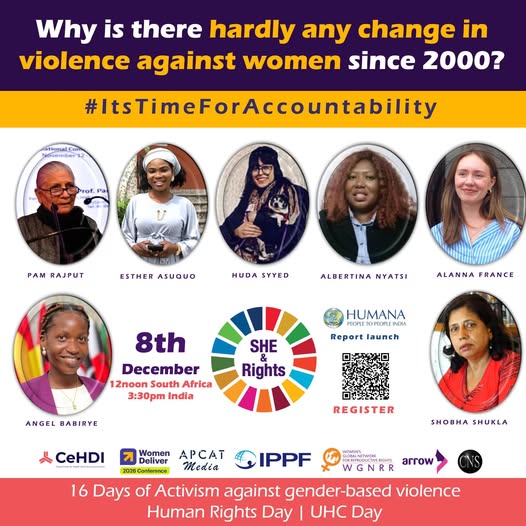
Health TV Online\Kathmandu: A SHE & Rights (Sexual Health with Equity & Rights) session-held during the 16 Days of Activism Against Gender-Based Violence and marking International Human Rights Day (10 December) and Universal Health Coverage (UHC) Day (12 December)—called for urgent action to connect human rights, universal health coverage (UHC) and ending gender-based violence (GBV).
Plenary keynote speaker Dr Pam Rajput said that violence against women and girls remains a grave human rights violation rooted in gender inequality and that global progress is far behind the goal of eliminating GBV. She cited staggering figures: over 840 million women worldwide have faced violence, 51,000 femicides, and rising violence in conflict settings. Women parliamentarians and journalists are also under attack, facing high levels of psychosocial and online violence. Dr Rajput stressed the need to dismantle structural inequalities, patriarchal norms, and under-investment in gender equality. “We demand zero tolerance for violence against women both in policy and practice,” she added.
Women parliamentarians and journalists are under attack, facing high levels of psychosocial and online violence. There is an immediate need to dismantle structural inequalities, patriarchal norms, and under-investment in gender equality.
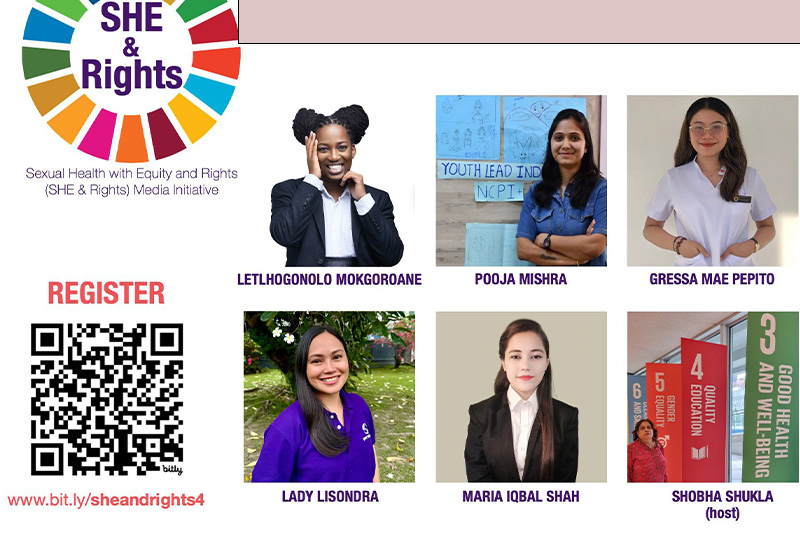
Shobha Shukla, SHE & Rights (Sexual Health with Equity & Rights) Coordinator and President of Asia Pacific Media Alliance for Health, Gender and Development Justice (APCAT Media), highlighted that there has been virtually no decline in violence since 2000, with only a 0.2% annual reduction in intimate partner and sexual violence. Although most countries have some form of domestic violence law, nearly half still lack comprehensive legislation, and global funding for addressing domestic violence has declined since 2022. She warned that the “1 in 3 women” statistic is likely a major underestimate.
Esther Asuquo of the African Girls Empowerment Network said GBV increases women’s vulnerability to forced sex, unsafe sex, and infections. Albertina Nyatsi, who led CNS coverage at ICASA 2025, stressed that the HIV and GBV cycle—driven by stigma, discrimination and power imbalances—can only be broken by integrating GBV services into HIV care and empowering women. Highlighting SDG-5 commitments, Dr Huda Syyed warned that over 230 million women and girls have undergone female genital mutilation or cutting (FGM/C), with a sharp rise reported in 2024. She said ending FGM/C is central to bodily autonomy, public health, and gender justice.
Alanna France presented the new All-In Initiative, aimed at driving leadership and accountability to end GBV. She noted GBV is entirely preventable and referenced evidence showing up to 50% reductions in GBV within 2–3 years when effective interventions are adequately funded.
Angel Babirye from Uganda stressed that period poverty is a major but overlooked barrier to girls’ health, education and dignity. Unsafe menstrual materials lead to infections, while economic hardship pushes some girls into transactional sex, increasing risks of violence and HIV. In Uganda, 1 in 4 girls drops out of school after reaching menstruation; absenteeism triples during periods. Babirye called for comprehensive menstrual hygiene support, safe sanitation facilities and normalisation of menstrual health discussions.
This SHE & Rights session was co- hosted by Global Center for Health Diplomacy and Inclusion (CeHDI), Women Deliver Conference 2026, International Planned Parenthood Federation (IPPF), Asian-Pacific Resource and Research Centre for Women (ARROW), Women’s Global Network for Reproductive Rights (WGNRR), Asia Pacific Media Alliance for Health, Gender and Development Justice (APCAT Media) and CNS.

नेपालमा क्यान्सर सर्भाइभरलाई केन्द्रमा राखेर विशेष कार्यक्रम
नेपाल क्यान्सर सम्मेलन सम्पन्न
औषधिलाई नै नटेर्ने संक्रमण : विश्वसामु बढ्दो एएमआर चुनौती
मेवाका फाइदा
मुटुरोगबाट बच्न के गर्ने ?